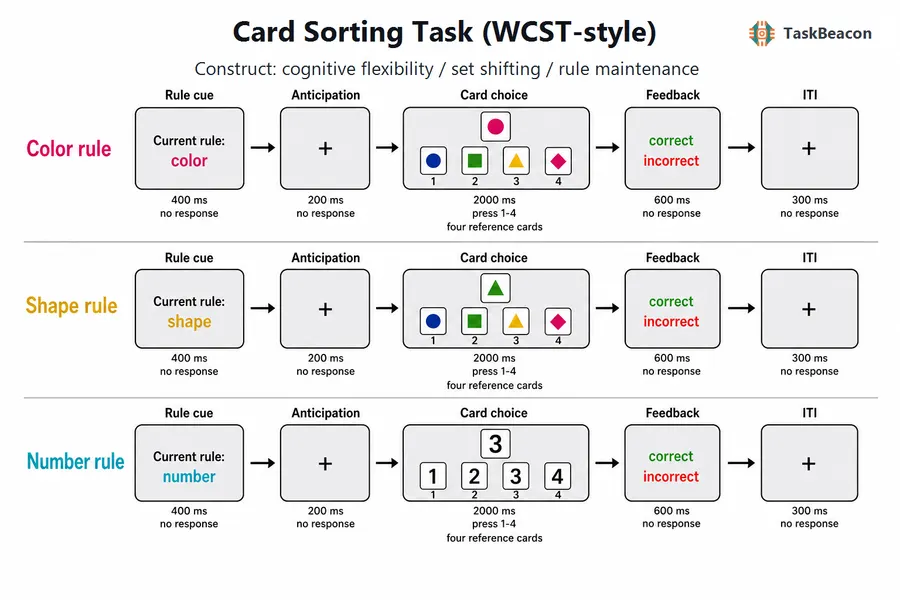
Card Sorting Task (WCST-style)

| Field | Value |
|---|
| Name | Card Sorting Task (WCST-style) |
| Version | v0.1.0-dev |
| URL / Repository | https://github.com/TaskBeacon/T000016-card-sorting |
| Short Description | Rule-based card sorting task for cognitive flexibility and set-shifting |
| Created By | TaskBeacon |
| Date Updated | 2026-02-17 |
| PsyFlow Version | 0.1.9 |
| PsychoPy Version | 2025.1.1 |
| Modality | Behavior |
| Language | Chinese |
| Voice Name | zh-CN-YunyangNeural |
1. Task Overview
This task implements a WCST-style card sorting paradigm in which participants classify target cards according to a currently active rule (color, shape, or number). The rule changes by block, and each trial requires mapping the target card to one of four reference cards using keys 1-4. The implementation supports human, qa, and sim modes, includes trigger emissions for all major phases, and logs trial-level behavioral outcomes from config-driven rule conditions plus deterministic in-trial target generation.
2. Task Flow
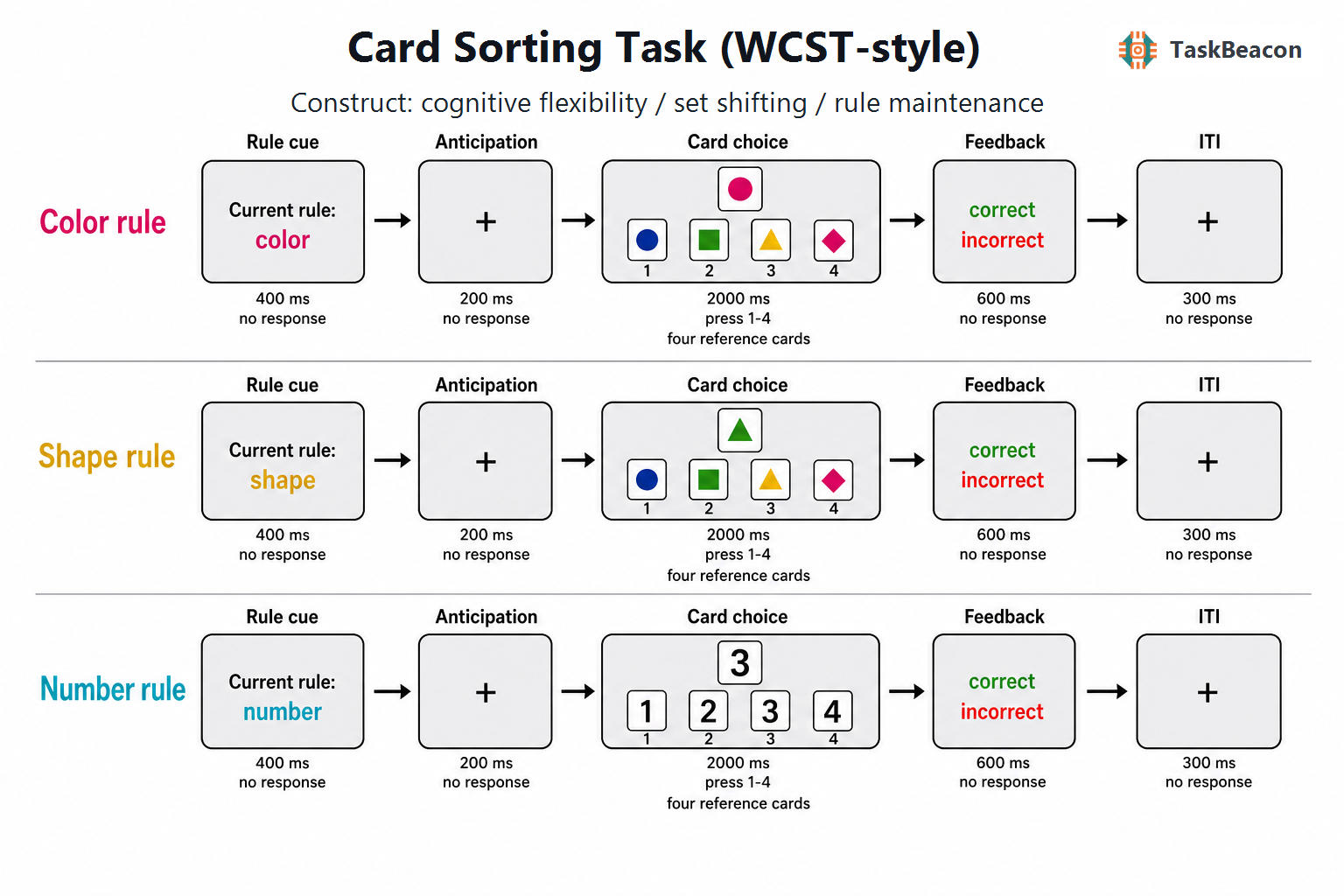
Block-Level Flow
| Step | Description |
|---|
| 1. Parse runtime mode and config | main.py resolves mode (human, qa, sim) and loads the selected YAML profile into TaskSettings. |
| 2. Build participant context | Human mode opens SubInfo form; QA uses subject_id=qa; sim uses session participant ID. |
| 3. Initialize runtime | Window/keyboard are initialized; trigger runtime uses mock in QA/sim and configured driver in human mode. |
| 4. Load stimuli | StimBank preloads all configured stimuli (fixation, rule cue, card images, feedback, block break, goodbye). |
| 5. Build block trial conditions | BlockUnit.generate_conditions(...) uses the built-in generator to create plain rule-label conditions per block (e.g., repeated color labels for the color block). |
| 6. Start experiment | Send exp_onset trigger and show instruction screen; wait for continue key. |
| 7. Enter block loop | For each of total_blocks=3, choose rule by index from conditions=[color, shape, number]. |
| 8. Optional countdown | Human mode shows a 3-second countdown before block start. |
9. Run BlockUnit | Block sends block_onset, runs trials from plain rule labels, then sends block_end. |
| 10. Compute block summary | After each block, compute accuracy and score from block trial data. |
| 11. Show block break | Present formatted rule-specific block break text (block_break_color/shape/number) with block index, accuracy, and total score. |
| 12. Finalize | Show good_bye with final score, send exp_end, save CSV, close trigger runtime, and quit PsychoPy. |
Trial-Level Flow
| Step | Description |
|---|
| 1. Load trial condition | run_trial.py receives one rule label (color / shape / number), allocates a trial ID, and deterministically samples a target-card feature combination plus correct key. |
| 2. Cue phase | Show rule_cue for cue_duration=0.4s; emit rule-specific cue trigger (color_cue_onset / shape_cue_onset / number_cue_onset). |
| 3. Anticipation phase | Show fixation for anticipation_duration=0.2s with anticipation_onset trigger. |
| 4. Target phase | Draw target card plus four reference cards; open response window (target_duration=2.0s) for keys 1,2,3,4; emit target_onset, key_press, and no_response as applicable. |
| 5. Response state writeback | Store response key, correctness (hit), correct key, and target features into trial data. |
| 6. Feedback phase | Show either feedback_correct or feedback_incorrect for feedback_duration=0.6s; emit feedback_onset. |
| 7. ITI phase | Show fixation for iti_duration=0.3s with iti_onset trigger. |
| 8. Return trial record | Return fully populated trial dictionary to block-level collector. |
Condition Generation Logic
| Component | Description |
|---|
| Feature spaces | Fixed feature sets in src/utils.py: 4 colors (RED/GREEN/BLUE/YELLOW), 4 shapes (CIRCLE/TRIANGLE/STAR/SQUARE), 4 numbers (1-4). |
| BlockUnit integration | main.py uses the basic BlockUnit.generate_conditions(...) path with plain config condition labels. |
| Block condition content | Each block condition is a simple rule label (color, shape, number), which keeps block logs easy to audit. |
| Trial spec sampler | sample_card_trial_spec(rule, key_list, seed) in src/utils.py shuffles feature indices and computes the rule-dependent correct key using task.key_list. |
| Target image binding | run_trial.py generates the target image path at trial runtime from the sampled feature tuple. |
| Auditability | Rule assignment is visible in block conditions, while target-feature sampling is deterministic from block seed + trial ID and logged in trial data (trial_seed, condition_id). |
Controller Logic
| Component | Description |
|---|
| Adaptive controller | Not used in this task. |
| Rationale | T000016 does not require online RT-window adjustment or staircase control. |
| Replacement pattern | src/utils.py only provides lightweight target-feature sampling helpers; main.py uses standard BlockUnit.generate_conditions(...). |
Other Logic
| Component | Description |
|---|
| Scoring | Feedback state sets delta=1 for correct and delta=0 otherwise; block and final scores sum these deltas. |
| Rule cue/break text | Participant-facing Chinese rule text is defined directly in config stimuli (rule_cue_color/shape/number, block_break_color/shape/number). |
| Trial context plumbing | Every major stage (rule_cue, pre_choice_fixation, card_choice_response, choice_feedback, iti) calls set_trial_context(...) for responder/simulation compatibility and auditability. |
Runtime Context Phases
| Phase Label | Meaning |
|---|
rule_cue | rule cue stage in src/run_trial.py responder context. |
pre_choice_fixation | pre choice fixation stage in src/run_trial.py responder context. |
card_choice_response | card choice response stage in src/run_trial.py responder context. |
choice_feedback | choice feedback stage in src/run_trial.py responder context. |
iti | inter-trial fixation stage in src/run_trial.py responder context. |
3. Configuration Summary
All settings are defined in config/config.yaml.
a. Subject Info
| Field | Meaning |
|---|
| subject_id | Required participant ID, integer, 3 digits, constrained to 101-999. |
b. Window Settings
| Parameter | Value |
|---|
| size | [1280, 720] |
| units | pix |
| screen | 0 |
| bg_color | black |
| fullscreen | false |
| monitor_width_cm | 35.5 |
| monitor_distance_cm | 60 |
c. Stimuli
| Name | Type | Description |
|---|
| fixation | text | Center + shown in anticipation and ITI. |
| instruction_text | text | Chinese task instruction with key mapping (1-4) and start prompt. |
| rule_cue_color / shape / number | text | Rule-specific cue text (当前规则:颜色 / 当前规则:形状 / 当前规则:数量) shown at trial start. |
| target_card | image | Target card image rebuilt per trial from the sampled feature combination. |
| ref_card_1 | image | Reference card #1 (left-most response option). |
| ref_card_2 | image | Reference card #2. |
| ref_card_3 | image | Reference card #3. |
| ref_card_4 | image | Reference card #4 (right-most response option). |
| feedback_correct | text | Positive feedback (正确). |
| feedback_incorrect | text | Error feedback (错误). |
| block_break_color / shape / number | text | Rule-specific inter-block summary with accuracy and score. |
| good_bye | text | Final completion screen with total score. |
d. Timing
| Phase | Duration |
|---|
| cue | 0.4 s |
| anticipation | 0.2 s |
| target response window | 2.0 s |
| feedback | 0.6 s |
| iti | 0.3 s |
e. Triggers
| Event | Code |
|---|
| exp_onset | 98 |
| exp_end | 99 |
| block_onset | 100 |
| block_end | 101 |
| color_cue_onset | 20 |
| shape_cue_onset | 21 |
| number_cue_onset | 22 |
| anticipation_onset | 25 |
| target_onset | 30 |
| key_press | 40 |
| no_response | 41 |
| feedback_onset | 50 |
| iti_onset | 60 |
f. Condition Sampling
| Parameter | Value |
|---|
| seed source | settings.block_seed[block_i] (PsyFlow-generated per block) |
| random source | Python random.Random(trial_seed), where trial_seed = block_seed * 1000 + trial_id |
| rule types | color, shape, number |
| response space | keys 1-4 |
| adaptation style | No adaptive controller; basic BlockUnit condition generation + deterministic in-trial sampling |
4. Methods (for academic publication)
Participants completed a rule-based card sorting task designed to probe set-shifting and cognitive flexibility. Before the task started, instructions explained that each trial required classifying a target card using one of four response keys (1-4) corresponding to four reference cards displayed at the bottom of the screen. The active rule was provided by a cue at the beginning of each trial and changed across blocks (color, shape, number). Trials were organized into three blocks with 32 trials each (96 total trials), with one rule per block.
Each trial began with a rule cue (0.4 s), followed by a short anticipation fixation (0.2 s). The target card and reference cards were then displayed, and participants had up to 2.0 s to respond. Responses were evaluated against the rule-defined correct key based on the active rule and explicit trial feature specification. Feedback was shown for 0.6 s as either correct or incorrect, followed by a 0.3 s inter-trial fixation interval. Event triggers were emitted at experiment, block, and phase transitions to support synchronization and downstream analysis.
A task utility deterministically samples per-trial feature combinations (color, shape, number) from the active rule and computes rule-specific correct responses using the configured key list. Block-level summaries report accuracy and accumulated score using rule-specific break screens defined in config. This structure supports reproducible behavioral measurement of rule maintenance, rule switching across blocks, and response accuracy under explicit rule constraints while keeping trial logic easy to audit.