Delay Discounting Task

| Field | Value |
|---|
| Name | Delay Discounting Task |
| Version | v0.2.0-dev |
| URL / Repository | https://github.com/TaskBeacon/T000017-delay-discounting |
| Short Description | MCQ-27 style intertemporal choice task (smaller-sooner vs larger-later) |
| Created By | TaskBeacon |
| Date Updated | 2026-02-17 |
| PsyFlow Version | 0.1.9 |
| PsychoPy Version | 2025.1.1 |
| Modality | Behavior |
| Language | Chinese |
| Voice Name | zh-CN-YunyangNeural |
1. Task Overview
This task implements an MCQ-27 style delay discounting paradigm where participants repeatedly choose between a smaller-sooner (SS) and larger-later (LL) monetary option. Trial offers are generated from a fixed 27-item item pool using deterministic utility-based planning, with configurable randomization and side counterbalancing. The implementation supports human, qa, and sim modes, records choice and RT outcomes at trial level, and emits structured triggers for each phase.
2. Task Flow
Block-Level Flow
| Step | Description |
|---|
| 1. Parse mode and config | main.py resolves human/qa/sim and loads the requested YAML profile. |
| 2. Build participant context | Human mode uses full subject form; QA and sim use synthetic IDs from runtime context. |
| 3. Initialize runtime | Construct TaskSettings, initialize trigger runtime, window, keyboard, and preload all configured stimuli. |
| 4. Initialize condition generation config | main.py loads condition_generation settings (item pool, randomization, side counterbalancing) for deterministic planning helpers in src/utils.py. |
| 5. Start experiment | Emit exp_onset; show instruction screen and wait for continue key. |
| 6. Prepare block conditions | For each block (total_blocks=1), BlockUnit.generate_conditions(func=build_block_conditions, ...) generates readable magnitude-label conditions from a deterministic MCQ plan. |
| 7. Run trials | BlockUnit emits block_onset, executes run_trial(...) for each condition label, and run_trial.py reconstructs the exact item spec deterministically from block seed + trial position, then emits block_end. |
| 8. Compute block summary | After block, compute response rate, LL choice rate, and mean RT from collected trial records. |
| 9. Show block break | Present block summary screen (block_break) with formatted metrics. |
| 10. Finalize | Show final summary screen (good_bye), emit exp_end, save CSV, close trigger runtime, and quit PsychoPy. |
Trial-Level Flow
| Step | Description |
|---|
| 1. Resolve planned offer | run_trial.py derives block-trial index, reconstructs the deterministic block plan, and fetches the matching MCQ item spec (magnitude, amounts, delay, side assignment, item ID). |
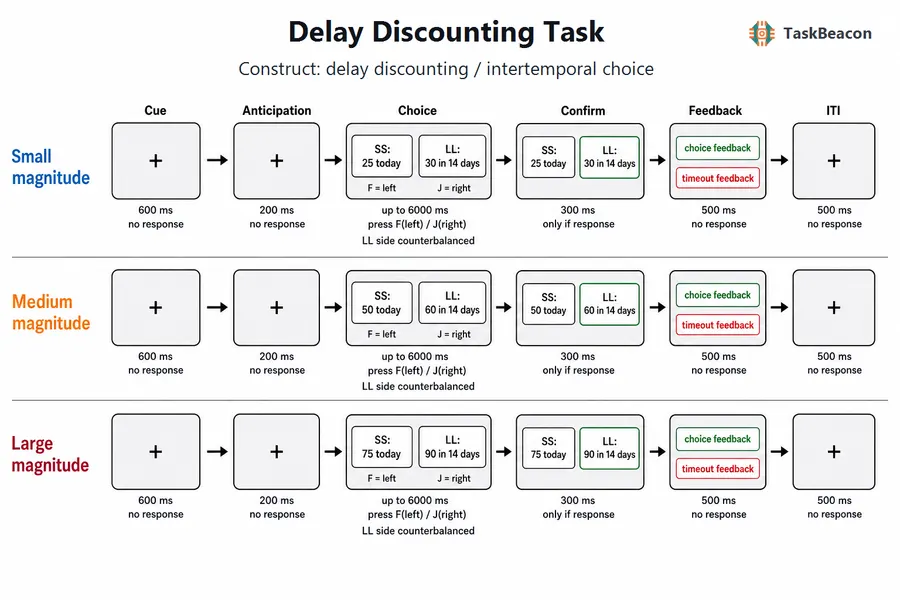
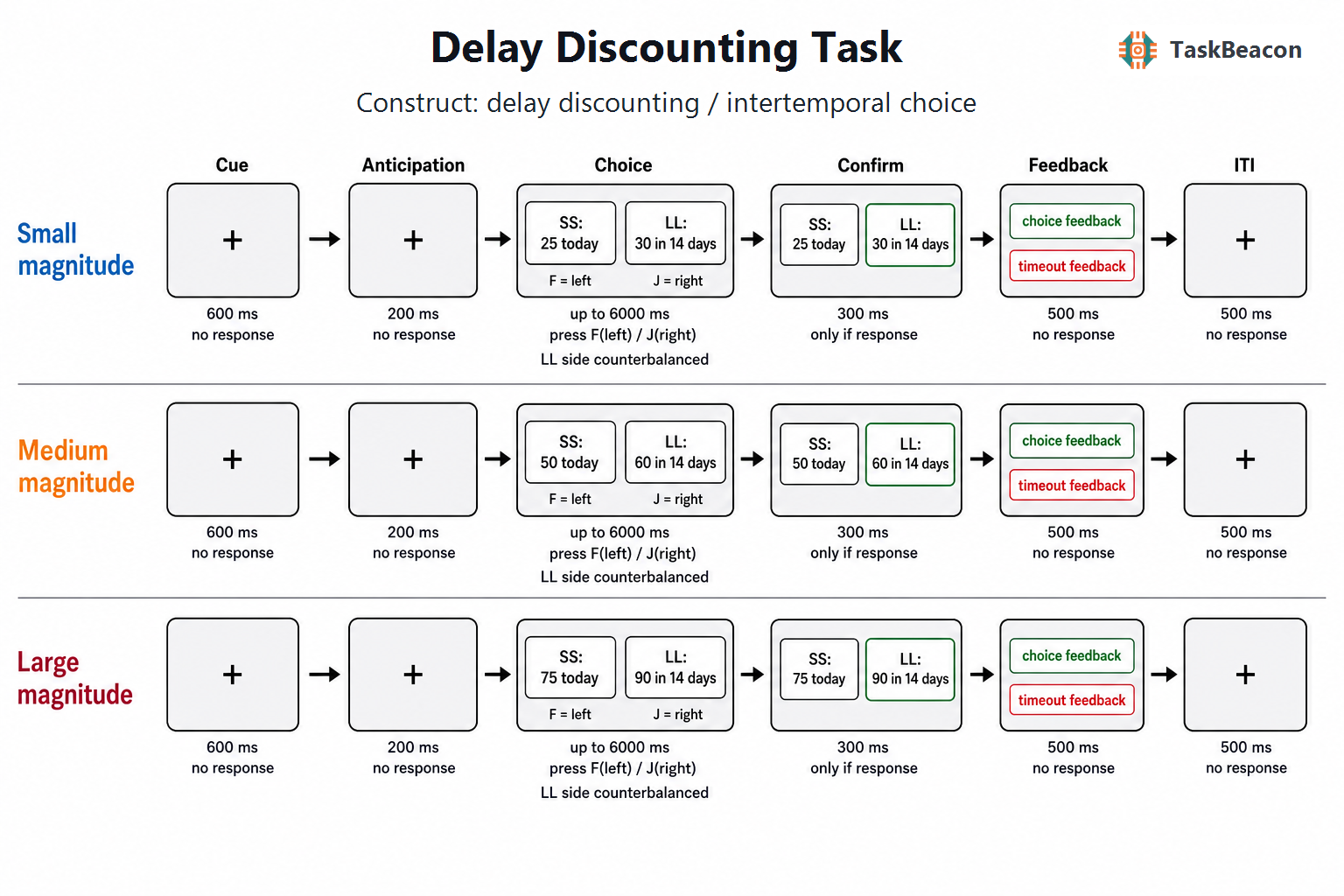
| 2. Cue phase | Show neutral fixation for cue_duration=0.6 s and emit cue_onset. Condition labels are intentionally not shown before choice. |
| 3. Anticipation phase | Show fixation for anticipation_duration=0.2 s and emit anticipation_onset. |
| 4. Choice phase | Draw left/right option text and choice prompt; collect f/j response within decision_duration=6.0 s; emit choice_onset, response trigger (31/32), or timeout trigger (39). |
| 5. Choice state derivation | Compute chosen side, chosen option (ss/ll), chosen amount, chosen delay, and LL indicator (chose_ll). |
| 6. Choice confirm phase (if responded) | Present both options plus a highlight rectangle on selected side for choice_confirm_duration=0.3 s; emit choice_confirm_onset. |
| 7. Feedback phase | If responded, show feedback_choice (feedback_choice_onset=40); if timeout, show feedback_timeout (feedback_timeout_onset=41) for feedback_duration=0.5 s. |
| 8. ITI phase | Show fixation for iti_duration=0.5 s and emit iti_onset. |
Controller Logic
| Component | Description |
|---|
| Adaptive controller | Not used in this task. |
| Rationale | Delay discounting here does not require adaptive RT-window control or staircase difficulty adjustment. |
Condition Generation Logic
| Component | Description |
|---|
| Item pool | Uses embedded/default 27-item MCQ table (MCQ27_ITEMS) or config-provided subset with fields: item ID, magnitude tier, SS amount, LL amount, delay days, and reference discount factor (k_ref). |
| Block plan generation | build_block_plan(...) deterministically builds a per-block trial list of length trial_per_block from item pool + seed and optional order randomization. |
| Side assignment | With counterbalance_sides=true, LL side is balanced across trials (half left, half right when possible) and shuffled by seed. |
| Option rendering fields | For each trial, utility planning computes left_amount/right_amount, left_delay_days/right_delay_days, ll_side, ss_side, and condition_id. |
| Trial serving | run_trial.py reconstructs the planned trial spec by block seed and block-trial index, and validates magnitude-label agreement with the BlockUnit condition. |
Other Logic
| Component | Description |
|---|
| Neutral pre-choice design | Although cue_text is defined in config, current trial logic intentionally presents fixation in cue phase to avoid exposing condition labels before choice. |
| Derived behavioral outputs | Trial data includes response presence, response key, RT, chosen side, chosen option, LL choice flag, and chosen value/delay fields. |
| Block-level metrics | Main loop computes response rate, LL rate among valid responses, and mean RT for block feedback text. |
| Trial context plumbing | Each stage (pre_choice_fixation, offer_onset_jitter, intertemporal_choice, choice_confirmation, outcome_feedback, inter_trial_interval) calls set_trial_context(...) for responder compatibility and simulation auditability. |
Runtime Context Phases
| Phase Label | Meaning |
|---|
pre_choice_fixation | pre choice fixation stage in src/run_trial.py responder context. |
offer_onset_jitter | offer onset jitter stage in src/run_trial.py responder context. |
intertemporal_choice | intertemporal choice stage in src/run_trial.py responder context. |
choice_confirmation | choice confirmation stage in src/run_trial.py responder context. |
outcome_feedback | outcome feedback stage in src/run_trial.py responder context. |
inter_trial_interval | inter trial interval stage in src/run_trial.py responder context. |
3. Configuration Summary
All settings are defined in config/config.yaml.
a. Subject Info
| Field | Meaning |
|---|
| subject_id | Required participant ID, integer, 3 digits, constrained to 101-999. |
| subname | Participant name string (pinyin label in mapping). |
| age | Integer age constrained to 5-60. |
| gender | Choice field with Male and Female. |
b. Window Settings
| Parameter | Value |
|---|
| size | [1280, 720] |
| units | pix |
| screen | 0 |
| bg_color | black |
| fullscreen | false |
| monitor_width_cm | 35.5 |
| monitor_distance_cm | 60 |
c. Stimuli
| Name | Type | Description |
|---|
| fixation | text | Center fixation + used in cue/anticipation/ITI. |
| instruction_text | text | Chinese instruction describing SS/LL choices and key mapping. |
| cue_text | text | Condition label text template (金额等级...) defined in config; currently not shown in trial runtime. |
| option_left | text | Left offer text stimulus, rebuilt each trial with concrete amount and delay. |
| option_right | text | Right offer text stimulus, rebuilt each trial with concrete amount and delay. |
| highlight_left | rect | Left-side selection highlight rectangle shown after response. |
| highlight_right | rect | Right-side selection highlight rectangle shown after response. |
| choice_prompt | text | Neutral choice prompt shown during decision window. |
| feedback_choice | text | Feedback text for valid choices. |
| feedback_timeout | text | Feedback text for missed responses. |
| block_break | text | Block summary text with response rate, LL rate, and mean RT. |
| good_bye | text | Final summary with total trials, valid trials, and LL rate. |
d. Timing
| Phase | Duration |
|---|
| cue | 0.6 s |
| anticipation | 0.2 s |
| choice response window | 6.0 s |
| choice confirm | 0.3 s |
| feedback | 0.5 s |
| iti | 0.5 s |
e. Triggers
| Event | Code |
|---|
| exp_onset | 1 |
| exp_end | 2 |
| block_onset | 10 |
| block_end | 11 |
| cue_onset | 20 |
| anticipation_onset | 25 |
| choice_onset | 30 |
| choice_response_left | 31 |
| choice_response_right | 32 |
| choice_confirm_onset | 33 |
| choice_no_response | 39 |
| feedback_choice_onset | 40 |
| feedback_timeout_onset | 41 |
| iti_onset | 50 |
f. Condition Generation
| Parameter | Value |
|---|
| randomize_order | true (condition_generation.randomize_order) |
| counterbalance_sides | true (condition_generation.counterbalance_sides) |
| ll_left_prob | 0.5 (condition_generation.ll_left_prob, used when side counterbalancing is disabled) |
| enable_logging | true (condition_generation.enable_logging) |
| item pool size | 27 MCQ items by default (or config-provided subset under condition_generation.item_pool) |
| seed behavior | Block seed passed via settings.block_seed[block_i]; produces deterministic block plan for fixed seed |
| adaptation style | Non-adaptive deterministic item/side planning via src/utils.py helpers |
4. Methods (for academic publication)
Participants performed a delay discounting task based on the 27-item Monetary Choice Questionnaire framework. On each trial, they selected between two monetary options: a smaller immediate reward (SS) and a larger delayed reward (LL). The task used one block of 27 trials, with item content spanning small, medium, and large magnitude tiers. Responses were made with two keys (F/J) mapped to left/right options.
Each trial started with a neutral fixation cue (0.6 s) and a brief anticipation interval (0.2 s), followed by the decision screen (maximum 6.0 s). The decision screen displayed two option texts containing amount and delay information. If a choice was made, a short confirmation stage (0.3 s) highlighted the selected side without revealing internal condition labels; then feedback was shown for 0.5 s. Missed trials produced timeout feedback. A 0.5 s inter-trial interval separated trials.
Offer generation is implemented by deterministic utility helpers initialized from the configured block seed, with optional order randomization and side counterbalancing to distribute LL placement across left and right positions. Behavioral outputs included response rate, reaction time, choice side, and LL choice proportion at both trial and block level. Event markers were emitted for all principal phases to support synchronized behavioral and neurophysiological analyses.