Cyberball Task

| Field | Value |
|---|
| Name | Cyberball Task |
| Version | v0.1.1-dev |
| URL / Repository | https://github.com/TaskBeacon/T000034-cyberball |
| Short Description | Three-player virtual ball-toss paradigm for social inclusion and ostracism. |
| Created By | TaskBeacon |
| Date Updated | 2026-02-19 |
| PsyFlow Version | 0.1.9 |
| PsychoPy Version | 2025.1.1 |
| Modality | Behavior |
| Language | English |
| Voice Name | en-US-AriaNeural (voice disabled by default) |
1. Task Overview
This task implements Cyberball as a three-player virtual ball game based on Williams & Jarvis (2006), with one participant and two avatars. Experimental manipulation is block-level social context:
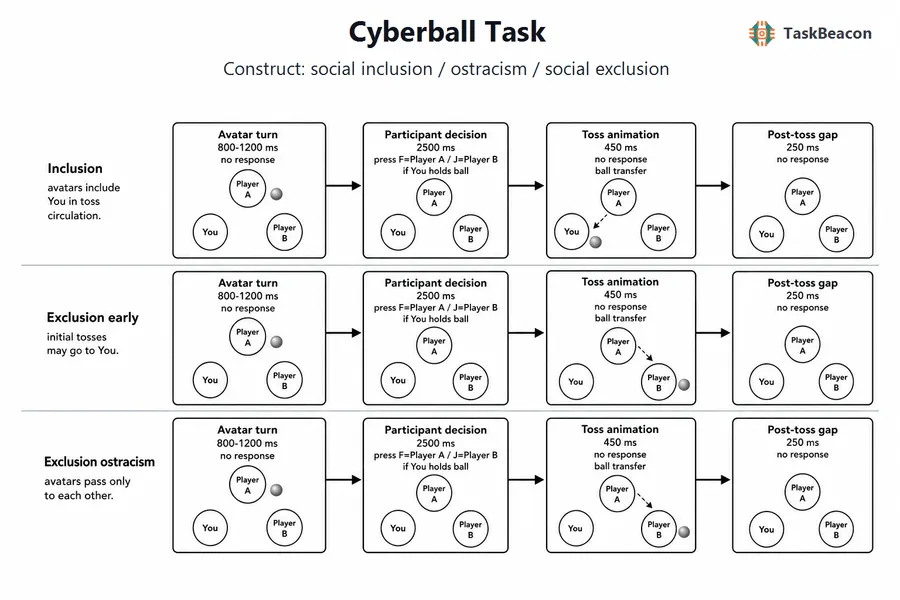
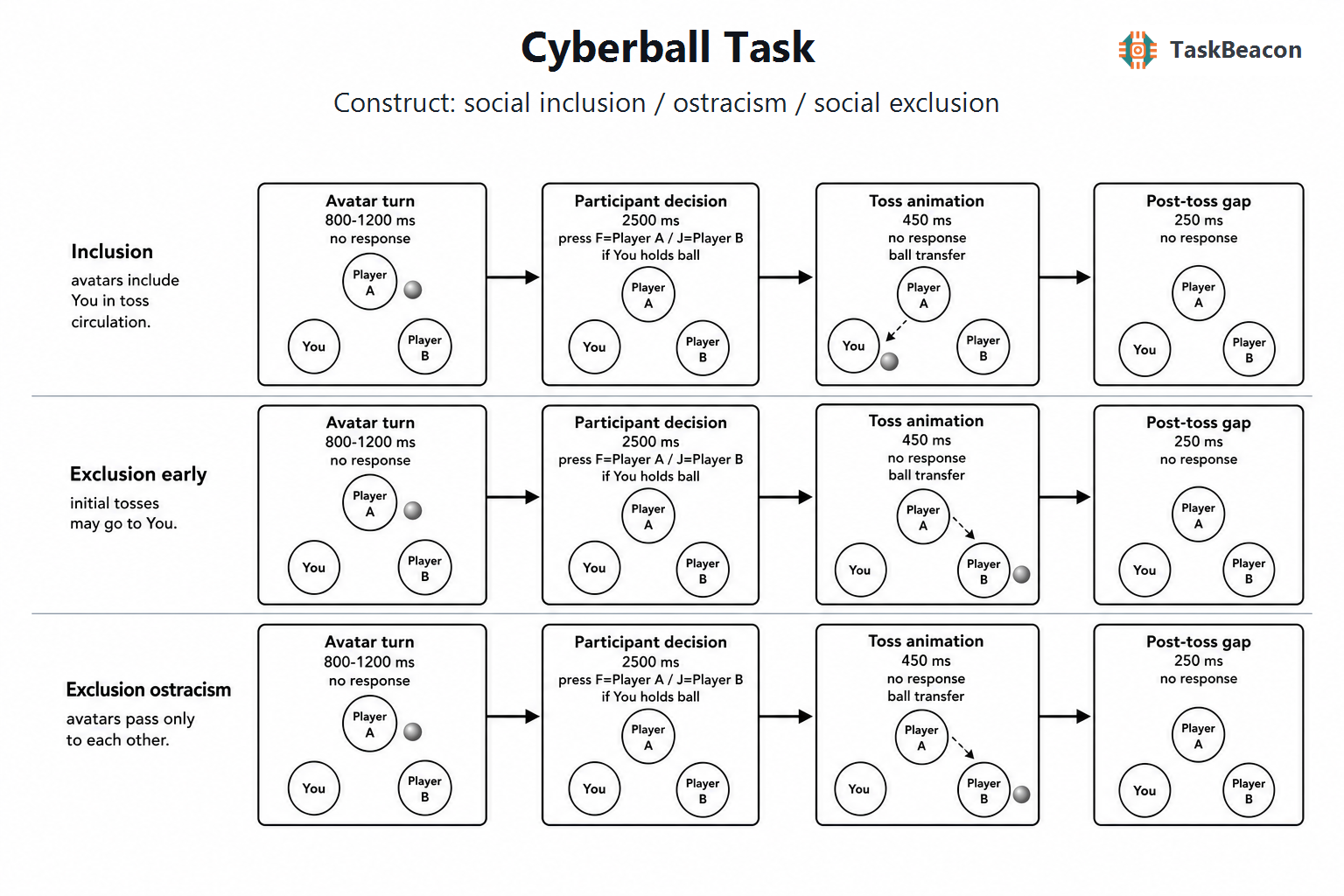
inclusion: avatars continue to involve the participant in toss circulation.exclusion: participant is initially included, then avatars toss only to each other.
Each toss event is logged as one auditable trial to satisfy PsyFlow/TAPS trial-level runtime contracts.
2. Task Flow
Block-Level Flow
| Step | Description |
|---|
| 1. Block setup | Select current condition (inclusion or exclusion) and reset controller state. |
| 2. Toss loop | Run trial_per_block toss events using shared ball-holder state. |
| 3. Block summary | Show block feedback with participant receive/turn counts. |
| 4. Completion | Show final summary and save trial log CSV. |
Trial-Level Flow
| Step | Description |
|---|
avatar_turn | If an avatar holds the ball, show waiting scene for randomized delay and choose next holder by condition policy. |
participant_decision | If participant holds the ball, capture f/j decision with timeout fallback policy. |
toss_animation | Animate ball transfer to target holder and log toss outcome fields. |
Controller Logic
| Component | Description |
|---|
| Toss policy | Inclusion uses probabilistic avatar-to-participant passing; exclusion switches to avatar-only passing after initial receives. |
| Block state | Tracks toss count and participant receives per block and globally. |
| Timeout fallback | On missed participant decision, target is selected by configured fallback policy. |
Runtime Context Phases
| Phase Label | Meaning |
|---|
avatar_turn | Avatar holds ball and decision latency is simulated. |
participant_decision | Participant response window (f/j) when ball is at participant node. |
3. Configuration Summary
a. Subject Info
| Field | Meaning |
|---|
subject_id | 3-digit participant identifier. |
b. Window Settings
| Parameter | Value |
|---|
size | [1280, 720] |
units | pix |
screen | 0 |
bg_color | black |
fullscreen | false |
monitor_width_cm | 35.5 |
monitor_distance_cm | 60 |
c. Stimuli
| Stimulus Group | Description |
|---|
participant_node, left_node, right_node | Three-player scene nodes (participant bottom, avatars top-left/top-right). |
participant_label, left_label, right_label | Player identity labels anchored to each node. |
ball | Shared ball rendered and moved between holder nodes. |
avatar_wait_prompt, participant_prompt, status_line | Phase prompt and block-condition status overlays. |
instruction_text, block_break, good_bye | Entry, transition, and exit screens. |
d. Timing
| Stage | Duration |
|---|
| avatar decision delay | uniform range from avatar_decision_delay |
| participant decision | participant_timeout |
| toss animation | toss_animation_duration |
| post-toss gap | inter_toss_interval |
4. Methods (for academic publication)
Participants engaged in a virtual three-player ball-toss task designed to manipulate perceived social inclusion versus ostracism. One block implemented inclusion dynamics and one block implemented exclusion dynamics. During participant-held ball states, participants selected toss targets via key responses (f/j), while avatar-held states followed condition-specific toss policies.
The implementation records one trial per toss event with explicit holder transitions, decision outcomes, timeout handling, and trigger-aligned phase context. This trialization preserves the continuous interaction character of Cyberball while enabling auditable event-level behavioral analysis.